"Metabolism" gets blamed for everything and understood by almost no one. People say they have a "slow metabolism," chase "metabolism-boosting" foods, and wonder why fat burning feels impossible. The truth is more useful — and more hopeful — than the myths.
Your metabolism is not a single dial. It's the sum of several distinct processes, and only a few of them are worth your attention. This article breaks down exactly what affects fat burning, ranked by how much it really matters.
What This Article Covers
- What metabolism actually is
- The 4 parts of daily energy burn
- BMR: the biggest lever
- The thermic effect of food
- NEAT: the hidden fat-burner
- What "fat burning" really means
- The levers that actually work
- Water, green tea & thermogenics
- Where AquaSculpt™ fits in
- Frequently asked questions
- Scientific references
What Metabolism Actually Is
Metabolism is the total set of chemical processes your body uses to convert food into energy and keep you alive. In practical terms — the terms that matter for fat loss — your metabolism is best understood as your total daily energy expenditure (TDEE): every calorie you burn in 24 hours.
Fat burning happens when your body needs more energy than the food you've eaten provides, so it taps into stored fat to make up the difference. The question "what affects fat burning?" is really the question "what affects how many calories I burn — and how readily my body releases stored fat to do it?"
The Four Parts of Daily Energy Burn
Your TDEE is made up of four components. Understanding their relative sizes tells you exactly where to focus:
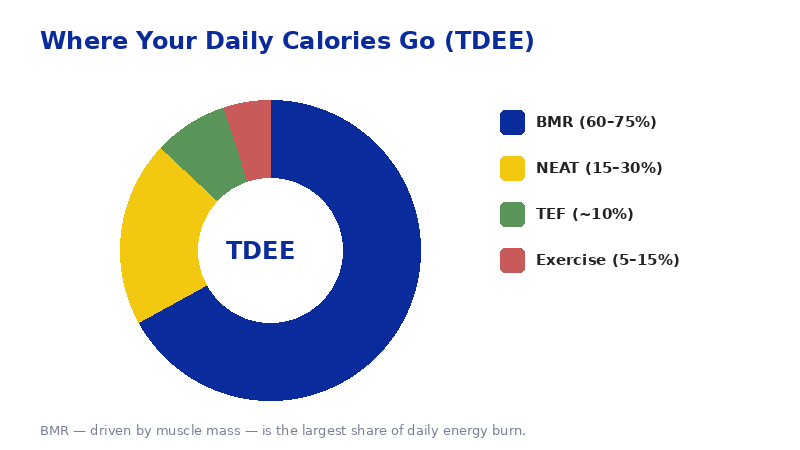
Most of your daily burn is BMR — which is why preserving muscle matters more than any single workout.
| Component | Share of TDEE | What it is |
|---|---|---|
| BMR | 60–75% | Calories to keep you alive at rest |
| NEAT | 15–30% | Everyday movement (walking, fidgeting, chores) |
| TEF | ~10% | Energy used to digest food |
| Exercise | 5–15% | Deliberate workouts |
BMR: The Biggest Lever You Can Influence
Your Basal Metabolic Rate is the energy your body burns just to exist — breathing, circulation, brain function, temperature regulation. It's the single largest slice of the pie, and the slice most worth protecting.
The biggest modifiable driver of BMR is lean muscle mass. Muscle tissue burns roughly 6 calories per pound per day at rest, versus about 2 for fat. That difference is why two people of the same weight can have very different metabolisms — and why losing muscle (through aging or crash dieting) quietly lowers the number of calories you burn around the clock.
You can't dramatically "speed up" your BMR with a food or a pill. But you can protect and slowly raise it by building and keeping muscle. This is the highest-leverage thing most people ignore.
The Thermic Effect of Food (TEF)
Digesting food costs energy. Roughly 10% of the calories you eat are spent breaking them down — but not equally across macronutrients:
- Protein: ~20–30% of its calories burned in digestion — by far the highest.
- Carbohydrates: ~5–10%.
- Fat: ~0–3% — the lowest.
This is one reason higher-protein diets support fat loss: more of each protein calorie is "lost" to digestion, and protein also preserves the muscle that keeps BMR high. Prioritizing protein is a two-for-one metabolic win.
NEAT: The Hidden Fat-Burner
Non-Exercise Activity Thermogenesis (NEAT) is every calorie you burn moving that isn't a formal workout: walking, standing, taking stairs, fidgeting, doing chores. NEAT varies enormously between people — sometimes by hundreds of calories a day — and it's far more controllable than most realize.
When people "diet," NEAT often quietly drops: they move less, sit more, and burn fewer calories without noticing. Deliberately keeping NEAT high — a daily step target, standing breaks, walking meetings — can rival or exceed the burn from a single gym session, every single day.
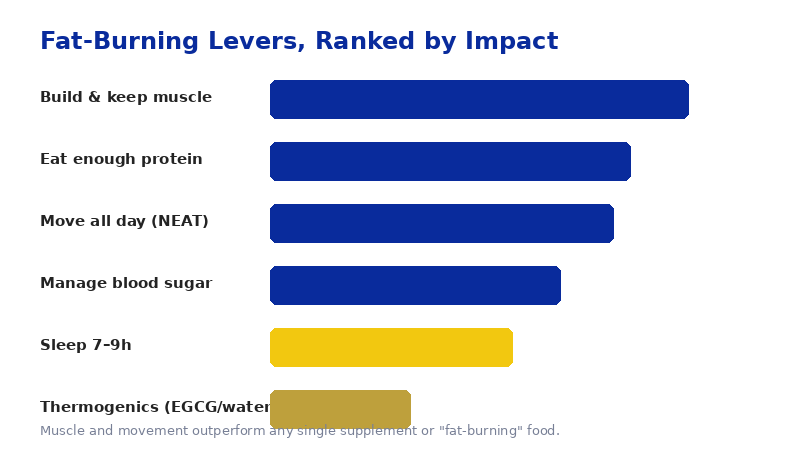
Ranked by real-world impact: muscle and movement beat any single 'fat-burning' food or supplement.
What "Fat Burning" Really Means
Burning fat (fat oxidation) is the process of breaking down stored fat into fatty acids and using them for fuel. Two things have to happen: fat must be released from storage (lipolysis), and it must be used by your cells' mitochondria.
This is where hormones matter. High insulin — driven by frequent blood sugar spikes — blocks fat release. That's why metabolism and blood sugar are tightly linked, and why managing your glucose response is part of any serious fat-loss strategy. (We cover that loop in detail in our blood sugar and belly fat guide.)
The Levers That Actually Work
Ranked by impact, here is where to spend your effort:
- Build & keep muscle. Resistance training 2–4×/week. Protects BMR, the biggest slice.
- Eat enough protein. 1.2–1.6 g/kg/day. Raises TEF, preserves muscle, controls appetite.
- Move all day (NEAT). Steps, standing, stairs. The most underrated daily burn.
- Manage blood sugar. Fewer refined carbs, protein/fiber first, walks after meals. Opens the fat-burning window.
- Sleep 7–9 hours. Poor sleep lowers metabolic rate and raises fat-storing hormones.
- Support thermogenesis. Hydration and certain compounds (below) add a small, consistent edge.
Water, Green Tea & Thermogenics — What the Evidence Says
This is where honesty matters. Some "metabolism boosters" have real but modest effects, and others are overhyped.
Drinking Water
A landmark study found that drinking 500 ml of water raised metabolic rate by about 30% for 30–60 minutes, with roughly 40% of that effect attributed to warming the water to body temperature.1 A follow-up in overweight adults reported a ~24% rise.2 Importantly, later research questioned how large and consistent this "water-induced thermogenesis" really is.3 The honest takeaway: staying well-hydrated — and cold water in particular — is a small, supportive habit, not a magic lever.
Green Tea Catechins (EGCG) & Caffeine
Green tea catechins, especially EGCG, combined with caffeine, have been shown in meta-analyses to modestly increase daily energy expenditure and fat oxidation.4 A systematic review found EGCG moderately accelerates energy expenditure and shifts the body toward burning fat, with effects most apparent around a 300 mg dose.5 Real — but moderate, and best stacked with the bigger levers above.
No food, drink, or supplement "supercharges" your metabolism on its own. The wins come from stacking: muscle + protein + movement + blood sugar control + sleep, with thermogenic support adding a small, consistent edge on top.
Where AquaSculpt™ Fits In
AquaSculpt™ is built around the thermogenic edge described above. Its formula combines compounds studied for energy expenditure and fat oxidation — such as EGCG and L-Carnitine — with ingredients that support insulin sensitivity and blood sugar balance, like Chromium and Alpha-Lipoic Acid. Paired with the morning cold-water "Ice Water Hack," the idea is to nudge daily thermogenesis upward.
It is honest to say it plainly: a supplement supports the smallest levers in the list, not the biggest. AquaSculpt™ is designed to complement muscle-building, protein intake, movement, and sleep — not replace them.
The Bottom Line
Fat burning isn't governed by a single mysterious "metabolism." It's the sum of your BMR (driven by muscle), the thermic effect of your food (driven by protein), your everyday movement (NEAT), and your hormonal environment (driven by blood sugar and sleep). Focus on those, in that order, and add small thermogenic supports on top. That's the whole science — and it works far better than chasing any single trick.
Support Your Daily Metabolism
AquaSculpt™ combines thermogenic and insulin-support ingredients to give your metabolism a daily edge. Try it risk-free for 60 days.
🛒 Order AquaSculpt™ — Only $39/BottleFrequently Asked Questions
Your BMR (driven by muscle mass) is the biggest factor, followed by everyday movement (NEAT), the thermic effect of food (highest for protein), and exercise. Building muscle, eating protein, and moving more matter far more than any single trick.
Some studies show ~500 ml of water can briefly raise resting energy expenditure (one reported ~30%), partly from warming the water. Later research questioned the size of the effect, so treat it as a small supportive habit, not a primary strategy.
Green tea catechins plus caffeine modestly increase energy expenditure and fat oxidation in meta-analyses. The effect is real but moderate, and works best alongside diet, training, and movement.
Scientific References
- Boschmann M, et al. Water-induced thermogenesis. J Clin Endocrinol Metab, 88(12), 6015–6019. PubMed 14671205
- Boschmann M, et al. Water drinking induces thermogenesis through osmosensitive mechanisms. J Clin Endocrinol Metab, 92(8). PubMed 17519319
- Brown CM, Dulloo AG, Montani JP. Water-induced thermogenesis reconsidered: effects of osmolality and water temperature. J Clin Endocrinol Metab, 91(9), 3598–3602. PubMed 16822824
- Beneficial Effects of Tea and the Green Tea Catechin Epigallocatechin-3-gallate on Obesity. Molecules, 21(10), 1305. PMC6274011
- Physiological effects of EGCG on energy expenditure for fat oxidation in humans: a systematic review and meta-analysis. J Nutr Biochem, 43, 1–10. PubMed 27883924
Last reviewed: June 8, 2026. Content is reviewed against current peer-reviewed literature and updated periodically.