If you eat reasonably well, move most days, and still can't shift the fat around your midsection, the problem may not be willpower — or even calories. For a large number of adults over 40, the real driver of stubborn belly fat sits one level deeper: blood sugar and the hormone that controls it, insulin.
This article unpacks the science of how chronic blood sugar swings quietly program your body to store abdominal fat — and why understanding the mechanism gives you far better tools than another round of restriction.
What This Article Covers
Insulin 101: The Fat-Storage Switch
Every time you eat — especially carbohydrates — your blood sugar (glucose) rises. In response, your pancreas releases insulin, a hormone with two jobs that matter enormously for body fat:
- It moves glucose out of the blood and into muscle, liver, and fat cells for use or storage.
- It switches off fat burning. Insulin is a powerful brake on lipolysis — the process by which stored fat is broken down and released for energy.
That second job is the part most people never hear about. When insulin is high, your body is biochemically told: store energy, don't burn it. In a healthy, insulin-sensitive person, insulin rises after a meal and falls quickly afterward, opening a window in which fat can be burned again. The trouble begins when insulin stays high all the time.
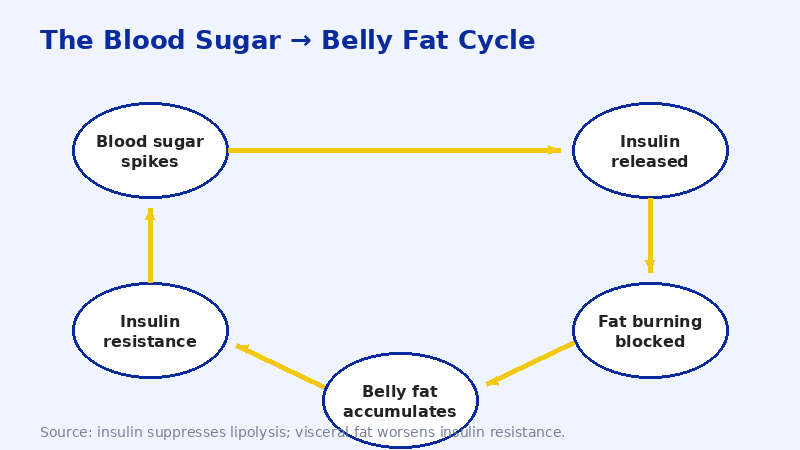
The self-reinforcing loop: blood sugar spikes drive insulin, insulin blocks fat burning and promotes storage, and the resulting abdominal fat worsens insulin resistance.
The Blood Sugar → Belly Fat Cycle
Here is the loop, step by step, that traps so many people:
- Repeated glucose spikes. Diets high in refined carbohydrates and added sugar produce frequent, sharp blood sugar surges.
- Chronically elevated insulin. To clear all that glucose, the pancreas pumps out insulin again and again, keeping levels high throughout the day.
- Fat burning is suppressed. With insulin high, lipolysis is inhibited. Stored fat — especially in the abdomen — stays locked away.
- Insulin resistance develops. Cells exposed to constant high insulin become less responsive, so the pancreas releases even more insulin to compensate.
- Abdominal fat accumulates and feeds back. Visceral fat is metabolically active and worsens insulin resistance further — tightening the loop.
Research in adults with upper-body obesity confirms a key piece of this: the ability of insulin to suppress fat release is measurably impaired, and abdominal fat is closely tied to whole-body insulin resistance.2 In type 2 diabetes, insulin's normal suppression of lipolysis is also blunted, which contributes to the accumulation of lipid byproducts and worsening insulin sensitivity.4
You don't get stubborn belly fat only because of how much you eat. You get it because of the hormonal environment your eating pattern creates. Chronically high insulin is a "store fat, don't burn it" signal — and belly fat both responds to and amplifies that signal.
Why Visceral Fat Is Different
Not all fat behaves the same. The fat just under your skin (subcutaneous fat) is relatively inert. The fat deep in your abdomen, wrapped around your organs — visceral fat — is a different beast entirely.
Visceral fat is metabolically active: it releases free fatty acids and inflammatory signals directly toward the liver, which impairs the body's ability to manage glucose and insulin. A 2025 cross-sectional analysis found that, among common obesity measures, visceral fat had the strongest predictive value for adipose-tissue insulin resistance — outperforming BMI, waist circumference, and total body fat percentage.3
It is worth noting that the science here is nuanced. Some researchers argue the relationship is partly correlative rather than purely causal, and that subcutaneous fat in the abdomen plays an important role too.1 What is not in dispute is that abdominal fat and insulin resistance travel together and reinforce one another.
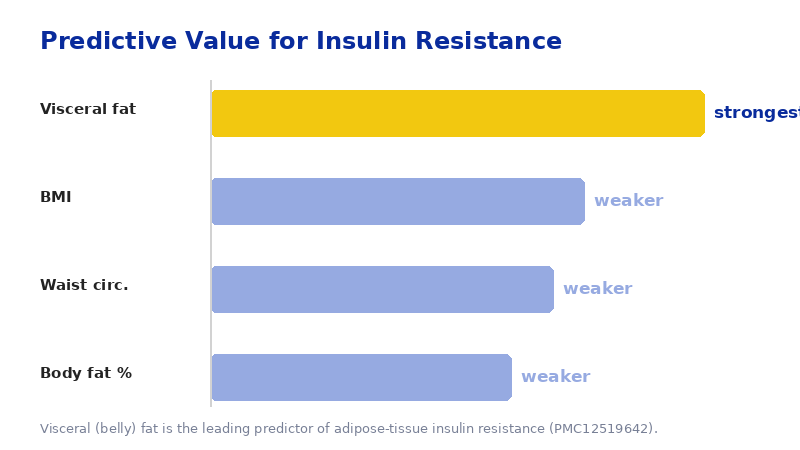
Abdominal (visceral) fat shows the tightest association with markers of insulin resistance compared with other common body measures.
Why Belly Fat Resists Dieting
This is the frustrating part. You cut calories, you lose a little weight — and the belly is the last thing to go, if it goes at all. The hormonal explanation:
- High insulin keeps the "fat-release" door shut. Even in a modest calorie deficit, if insulin stays elevated, lipolysis from abdominal depots remains suppressed.
- Abdominal fat is more insulin-resistant. The depots most linked to metabolic risk are also among the most stubborn to mobilize.
- Restriction can backfire. Crash diets that spike then crash blood sugar can leave you hungrier and more prone to the very refined-carb choices that perpetuate the cycle.
The takeaway is not "eat less and try harder." It's change the hormonal signal so your body is allowed to burn the fat you already have.
How to Break the Cycle: Evidence-Based Strategies
Improving insulin sensitivity reduces the hormonal environment that promotes abdominal fat storage. These are the levers with the strongest support:
1. Flatten Your Glucose Spikes
The single most direct lever. Reduce refined carbohydrates and added sugars, and reshape how you eat the carbs you keep: lead with protein and fiber, which slow glucose absorption and blunt the insulin response that follows.
2. Walk After Meals
Muscle is a glucose sponge. A 10–15 minute walk after eating pulls glucose out of the bloodstream without requiring extra insulin — directly lowering the post-meal spike that feeds the cycle.
3. Build and Keep Muscle
Resistance training improves the muscle's ability to take up glucose and increases insulin sensitivity for hours afterward. More muscle also means more places to store glucose as glycogen instead of converting it to fat.
4. Prioritize Sleep and Manage Stress
Poor sleep and chronic stress both raise cortisol, which raises blood sugar and promotes abdominal fat storage specifically. Protecting sleep is an underrated metabolic intervention.
5. Support Insulin Sensitivity Nutritionally
Several nutrients have research support for blood sugar regulation and insulin sensitivity, including Chromium (involved in insulin signaling) and Alpha-Lipoic Acid (an antioxidant studied for insulin sensitivity). These are among the ingredients formulated into AquaSculpt™.
| Strategy | What it does | Effort |
|---|---|---|
| Protein & fiber first | Blunts the glucose spike at each meal | Low |
| Post-meal walk | Clears glucose without extra insulin | Low |
| Resistance training | Raises insulin sensitivity, builds glucose storage | Medium |
| Sleep & stress | Lowers cortisol-driven belly fat storage | Medium |
| Targeted nutrients | Support insulin signaling (e.g. chromium, ALA) | Low |
Where AquaSculpt™ Fits In
AquaSculpt™ is designed to support the metabolic side of this picture — not to replace the lifestyle levers above. Its formula pairs ingredients studied for insulin sensitivity and blood sugar support (such as Chromium and Alpha-Lipoic Acid) with thermogenic compounds (such as EGCG and L-Carnitine) intended to support daily energy expenditure and fat oxidation.
The goal is straightforward: help create a hormonal environment in which the body is more willing to release stubborn abdominal fat, alongside the diet, movement, and sleep habits that do the heavy lifting. AquaSculpt™ is a dietary supplement — a complement to healthy habits, not a substitute for them.
If you have diabetes, prediabetes, or take medication that affects blood sugar, talk to your doctor before changing your diet or adding any supplement. Persistent unexplained belly fat, fatigue, or thirst deserve a proper medical evaluation — this article is educational and not a substitute for personalized medical advice.
The Bottom Line
Stubborn belly fat is rarely just a calorie problem. It's a signaling problem driven by chronic blood sugar swings and the high insulin they produce. Insulin tells the body to store fat and stops it from burning fat — and abdominal fat feeds that signal back in a self-reinforcing loop. Break the loop by flattening your glucose response, building muscle, protecting sleep, and supporting insulin sensitivity, and the fat that resisted every diet finally has a reason to move.
Support Your Metabolism & Blood Sugar Balance
AquaSculpt™ combines insulin-sensitivity and thermogenic ingredients to support healthy metabolism in adults 40+. Try it risk-free for 60 days.
🛒 Order AquaSculpt™ — Only $39/BottleFrequently Asked Questions
Chronically high blood sugar means chronically high insulin. Because insulin promotes fat storage and blocks fat breakdown, it makes abdominal fat easier to store and harder to lose — and belly fat then worsens insulin resistance in return.
High circulating insulin directly suppresses lipolysis, so even in a calorie deficit, fat release from abdominal depots is blunted. Those depots are also the most insulin-resistant, making them the most stubborn.
Lead meals with protein and fiber, cut refined carbs and added sugar, walk after eating, train with weights, and protect sleep. These flatten glucose spikes and improve insulin sensitivity — the foundation for losing abdominal fat.
Scientific References
- Frayn KN. Visceral fat and insulin resistance — causative or correlative? British Journal of Nutrition, 83(S1), S71–S77. Cambridge Core
- Insulin regulation of regional lipolysis in upper-body obese and lean humans. JCI Insight (2024). PMC11141918
- Visceral Fat As The Main Obesity Index That Determines The Occurrence of Adipose Tissue Insulin Resistance. PMC (2025). PMC12519642
- Insulin-mediated suppression of lipolysis in adipose tissue and skeletal muscle of obese type 2 diabetic men and men with normal glucose tolerance. Diabetologia. PMC3764323
- Boschmann M, et al. Water-induced thermogenesis. J Clin Endocrinol Metab, 88(12), 6015–6019. PubMed 14671205
Last reviewed: June 8, 2026. Content is reviewed against current peer-reviewed literature and updated periodically.