Few things in weight loss are as demoralizing as doing everything right and watching the scale refuse to budge. You've cut your portions, you're walking more, you've sworn off the obvious culprits — and yet the number stares back, unchanged, week after week.
If that's you, take a breath. A calorie deficit hasn't betrayed the laws of physics. What's almost certainly happening is that the deficit you think you have isn't the deficit your body is actually experiencing — and your metabolism has started quietly fighting back. Let's unpack the eight real reasons, in plain language, with the fixes that work.
What This Article Covers
The Calorie-Deficit Paradox
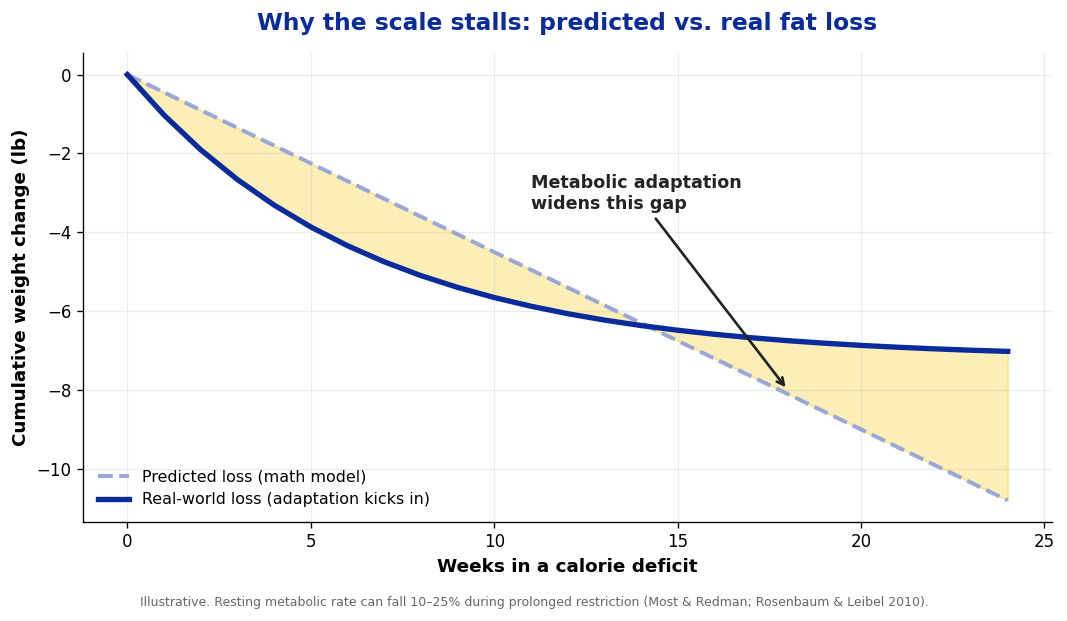
Here's the uncomfortable truth that nobody mentions when they tell you to "just eat less." A calorie deficit absolutely causes fat loss — but the deficit is a moving target. The moment you start losing weight, your body needs fewer calories to run, and it begins adjusting on multiple fronts to close the gap you created.
So you can be eating the exact same meals that worked in week one and be in barely any deficit by week ten. Nothing went wrong with your discipline. The math simply changed underneath you. Understanding how it changed is what lets you fix it.
The 8 Real Reasons the Scale Stalls
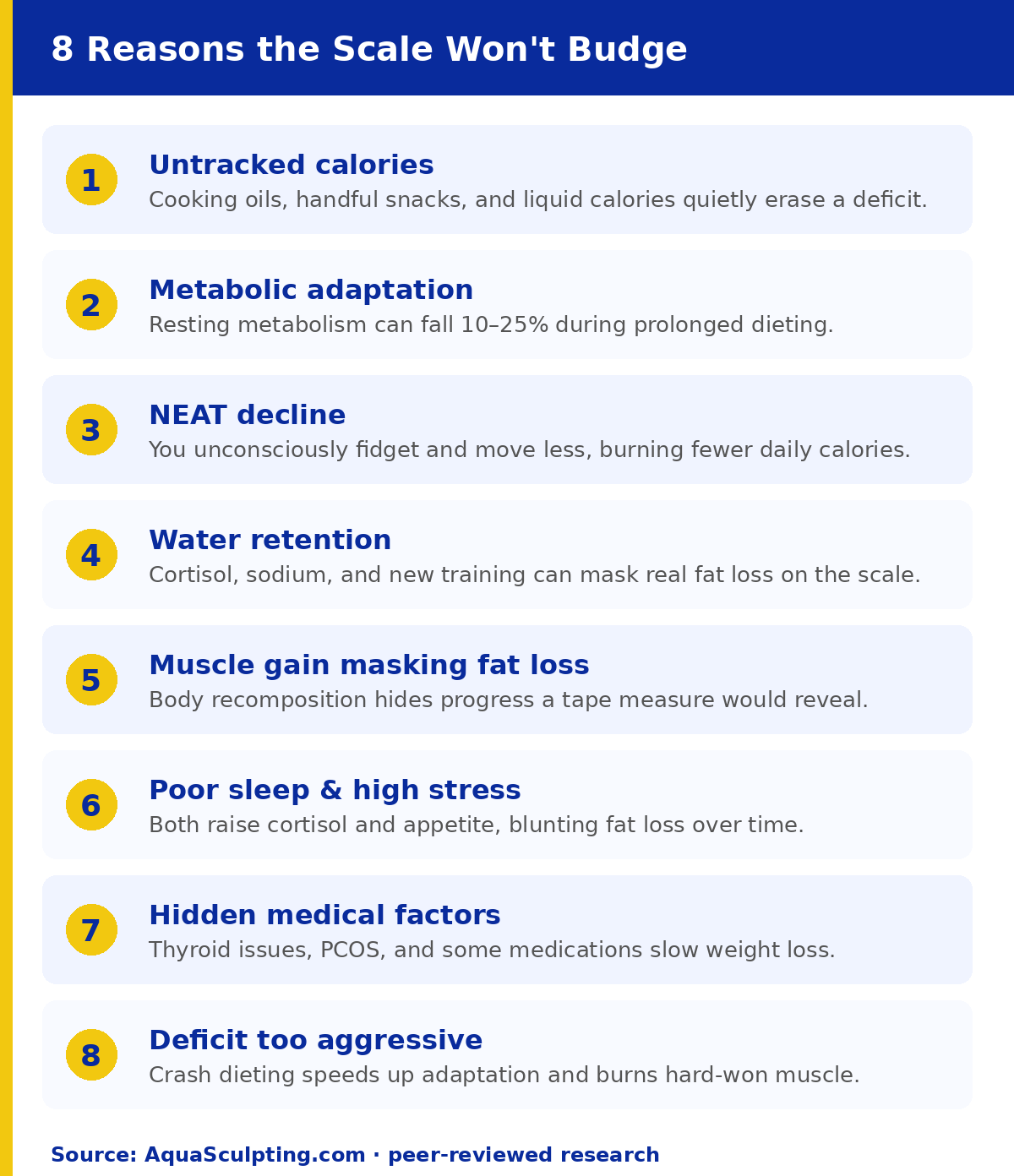
Plateaus almost always come from a combination of these, not a single villain. Read through all eight — you'll likely recognize two or three at once.
1. Untracked calories (the silent deficit killer)
This is the most common cause, full stop. A glug of olive oil, a few handfuls of nuts, a splash of cream, weekend drinks, "just a bite" while cooking — these add up fast and rarely get logged. Studies repeatedly find people underestimate intake by hundreds of calories. If your deficit has vanished on paper, it usually vanished here first.
2. Metabolic adaptation (your body conserves energy)
When you restrict calories for weeks, your body interprets it as a potential famine and slows down to protect you. Resting metabolic rate can drop by roughly 10–25%. This is called adaptive thermogenesis, and it's a survival feature, not a flaw — but it directly shrinks your deficit. We'll cover how to blunt it below.
3. NEAT decline (you move less without noticing)
NEAT — non-exercise activity thermogenesis — is all the movement that isn't formal exercise: fidgeting, pacing, taking the stairs, gesturing, standing. It can swing daily burn by hundreds of calories. When you diet, NEAT quietly falls: you sit a little more, move a little slower, take the shorter route. Your body is conserving energy behind your back.
4. Water retention is masking fat loss
You can lose fat and not see it for weeks because water is hiding the change. Stress (cortisol), high sodium, hormonal shifts, and especially new or intense training all cause the body to hold extra water. The fat is leaving; the scale just hasn't gotten the memo yet.
5. Muscle gain is offsetting fat loss
If you've recently started resistance training, you may be losing fat and building muscle at the same time — body recomposition. The scale barely moves because muscle is denser than fat. A tape measure and the fit of your clothes will tell a very different, more encouraging story.
6. Poor sleep and chronic stress
Short or broken sleep and ongoing stress raise cortisol, increase appetite and cravings, and make the body more inclined to hold onto fat and water. You can do everything else right and still stall if sleep and stress are working against you every night.
7. Hidden medical factors
Sometimes the cause is medical. An underactive thyroid, PCOS, insulin resistance, certain medications, and perimenopause can all slow weight loss. If you've genuinely tightened everything and still see nothing for many weeks, it's worth a conversation with your doctor and some basic bloodwork.
8. Your deficit is too aggressive
It sounds backwards, but slashing calories too hard often stalls progress. A severe deficit accelerates metabolic adaptation, burns muscle (which lowers metabolism further), tanks your energy, and crushes NEAT. A moderate, sustainable deficit usually outperforms a crash diet over any real time horizon.
Give Your Metabolism a Little Backup
AquaSculpt™ combines thermogenic and insulin-sensitivity ingredients to support a healthy metabolic rate in adults 40+ — designed to work alongside your deficit, not replace it.
🛒 Order AquaSculpt™ — Only $39/BottleMetabolic Adaptation, Explained Simply
This deserves its own section because it's the reason most diets "stop working." Your body runs on a kind of internal thermostat that prefers stability. When energy coming in drops, it lowers energy going out to match — the same way it can't tell the difference between a diet and a genuine food shortage.
Several things shift at once: resting metabolism falls, the hormones that control hunger and fullness change to make you hungrier, and unconscious movement (NEAT) decreases. Research on people who've lost significant weight shows these compensations can persist long after the active weight-loss phase. None of it means you're broken — it means your body is doing exactly what it evolved to do.
You don't beat metabolic adaptation by eating even less. You manage it by protecting muscle, refueling strategically, and rebuilding the movement and metabolic signals your body dialed down.
How to Break the Plateau
Here's the practical playbook, in order of what to try first:
1. Audit your intake for two weeks. Weigh and log everything — oils, sauces, drinks, bites — with no judgment. Most "mystery plateaus" resolve right here.
2. Anchor your protein. Higher protein protects muscle during a deficit and has the highest "thermic effect," meaning your body burns more digesting it. Protein is the single most important macro on a plateau.
3. Lift weights. Resistance training tells your body to keep its muscle, which keeps your metabolism higher and helps reverse adaptation.
4. Rebuild NEAT. Add a daily step target. Walking after meals is especially effective — it raises activity and helps blunt blood-sugar spikes.
5. Fix sleep and stress. Aim for consistent sleep and wake times and real stress decompression. This lowers cortisol, which eases water retention and cravings.
6. Take a diet break. A week or two at maintenance calories can ease metabolic adaptation, restore hormones, and make the next deficit phase work again. Counterintuitive, but well supported.
Why the Scale Lies — Use These Instead
The bathroom scale measures everything: fat, muscle, water, food in transit, glycogen. On any given morning it can swing two or three pounds for reasons that have nothing to do with fat. Relying on it alone during a plateau is a recipe for quitting something that's actually working.
| Better progress marker | What it reveals | How often to check |
|---|---|---|
| Waist circumference | Tracks abdominal (visceral) fat the scale can't see | Every 2 weeks |
| Progress photos | Shows recomposition when weight is steady but shape changes | Every 2–4 weeks, same lighting |
| How clothes fit | Honest, real-world read on fat loss | Ongoing |
| Weekly average weight | Smooths out daily water noise into a real trend | Daily weigh-ins, weekly average |
| Strength & energy | Signals you're keeping muscle and fueling well | Each workout |
Rapid, unexplained weight changes, persistent fatigue, or a long stall despite genuine effort deserve a proper medical evaluation — thyroid and hormonal issues are common and treatable. This article is educational and not a substitute for personalized medical advice.
Where AquaSculpt™ Fits In
If metabolic adaptation is the problem, the logical support is anything that helps keep your metabolic rate and energy expenditure from sliding too far. That's the niche AquaSculpt™ is designed for.
Its formula pairs thermogenic compounds studied for energy expenditure — EGCG from green tea and Cayenne Pepper — with L-Carnitine for fat oxidation and blood-sugar-supporting ingredients like Chromium, Alpha-Lipoic Acid, and Berberine. The aim is to support a healthier metabolic environment while you do the things that actually break plateaus: protein, lifting, steps, and sleep.
To be clear, AquaSculpt™ is a dietary supplement, not a workaround for the calorie equation. No capsule offsets an untracked deficit or replaces resistance training. It's a complement to the playbook above — a small, daily nudge in the right direction.
The Bottom Line
If you're "in a deficit" but not losing weight, the deficit has almost certainly shrunk — through untracked calories, metabolic adaptation, falling NEAT, or all three — while water and muscle changes hide the fat loss that is happening on the scale. The answer is rarely to eat even less. It's to tighten your tracking, anchor protein, lift weights, rebuild daily movement, fix sleep, and take strategic breaks — and to judge progress by your waist, your photos, and your clothes, not one number each morning. Work with your biology instead of against it, and the scale starts moving again.
Support a Metabolism That Won't Quit
AquaSculpt™ brings green tea EGCG, Cayenne, L-Carnitine, and insulin-support nutrients into one daily formula for adults 40+. Try it risk-free for 60 days.
🛒 Order AquaSculpt™ — Only $39/BottleFrequently Asked Questions
Usually a mix of untracked calories shrinking the deficit, metabolic adaptation lowering how much you burn, an unconscious drop in daily movement (NEAT), and water or muscle changes masking fat loss on the scale. Tighten tracking first, then protect muscle and rebuild activity.
It's your body's protective response to dieting: resting metabolism can fall 10–25%, hunger rises, and you move less — so the same deficit slows your loss. It eases with adequate protein, strength training, good sleep, and periodic diet breaks.
Confirm you're still in a deficit by tightening tracking for two weeks, prioritize protein and lifting to protect muscle, add daily steps, improve sleep and stress, and consider a short maintenance-calorie break. Track your waist and photos, not just the scale.
The physics never fails, but the deficit itself can shrink as you lose weight, metabolism adapts, and movement declines. The fix is to recalculate intake and rebuild activity — not to crash to ever-lower calories.
Scientific References
- Martins C, et al. Metabolic adaptation is not a major barrier to weight-loss maintenance / Metabolic Adaptation during Weight Loss: A Review. Obesity Reviews (2021). PMC7890696
- Rosenbaum M, Leibel RL. Adaptive thermogenesis in humans. Int J Obes (Lond). 2010;34(Suppl 1):S47–S55. PubMed 20935667
- Non-exercise activity thermogenesis (NEAT): a component of total daily energy expenditure. PMC (2018). PMC6058072
- Dulloo AG, et al. Efficacy of a green tea extract rich in catechin polyphenols and caffeine in increasing 24-h energy expenditure and fat oxidation in humans. Am J Clin Nutr. 1999;70(6):1040–1045. PubMed 10584049
- Boschmann M, et al. Water-induced thermogenesis. J Clin Endocrinol Metab. 2003;88(12):6015–6019. PubMed 14671205
Last reviewed: June 14, 2026. Content is reviewed against current peer-reviewed literature and updated periodically.